What happens when two returned Peace Corps volunteers — both drawn to food, politics, and community — stumble across a job listing for an agrihood farm in South Florida? For Carmen and Tripp Eldridge, it became the unlikely origin story of a new kind of career: designing and operating farm enterprises embedded within large-scale residential developments.
Their company, Convivial Foodscapes, is one of the few outfits in the country with the lived experience to back up its work. They haven't just theorized about agrihoods — they've started farms from scratch inside them, hired and trained the teams to run them, and returned for a second act with hard-won improvements in hand.
In this episode of The Regenerative Real Estate Podcast, host Neal Collins sits down with Carmen and Tripp to explore what it really takes to make agriculture work inside a residential community, from the earliest design decisions to the long-term challenges of keeping residents engaged, farmers motivated, and the whole operation financially coherent.
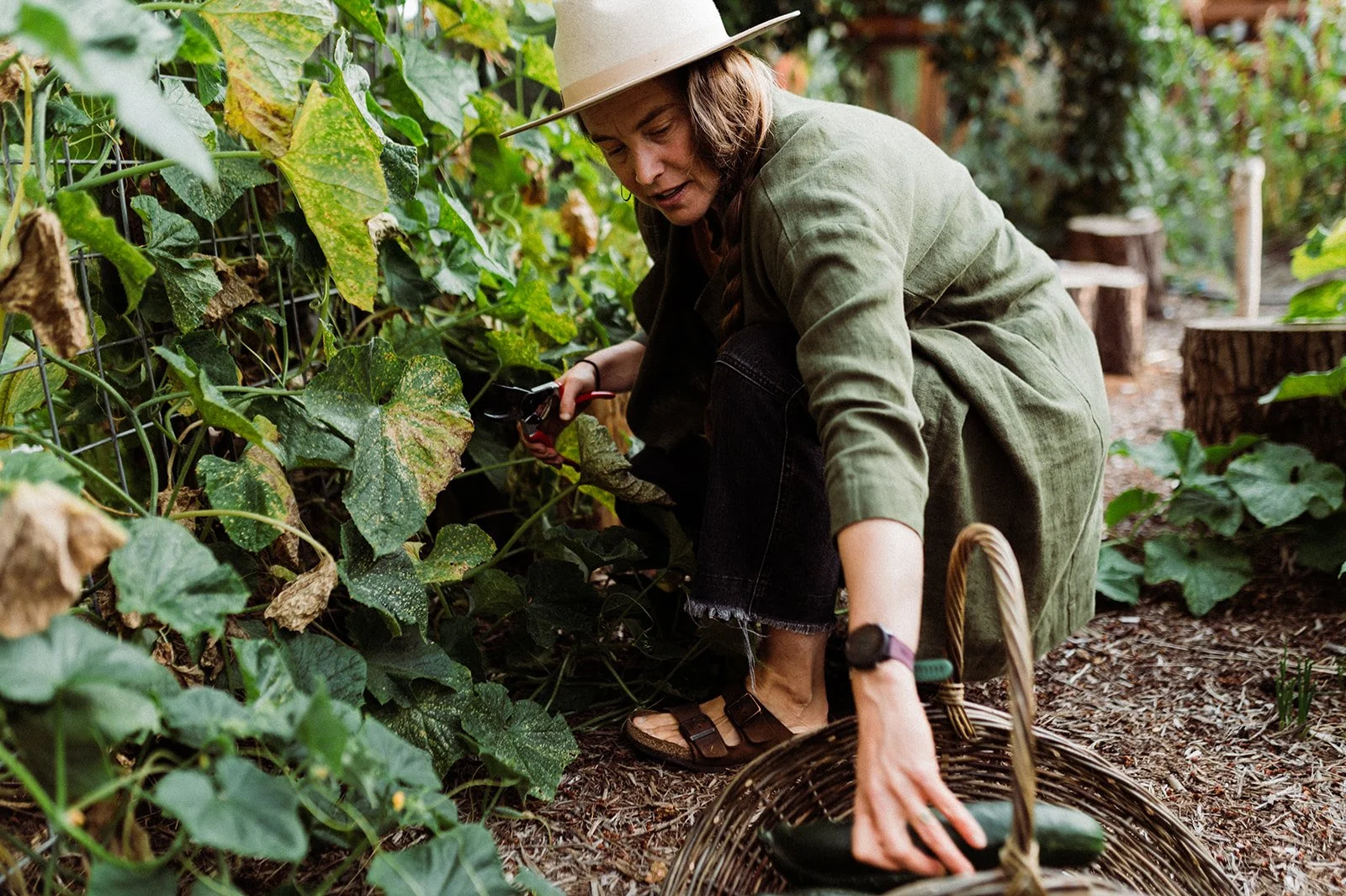
Tripp and Carmen
Two Paths to the Same Passion
Carmen's entry point was food politics. Growing up with grandparents who had immigrated from rural Spain — where farming was a matter of survival, not identity — she found herself fascinated by the intersection of agriculture, environment, and community education. Her trajectory took her through the University of Florida and into the Peace Corps in Panama, where she taught organic farming at an agroforestry high school in the Darien, one of the country's poorest provinces. She came back with field experience, a deep knowledge of tropical systems, and the conviction that she wanted to build a professional life around food.
Tripp's spark came later, during a college ecology course that included a tour of a CSA farm. He was studying sociology and anthropology — thinking about how humans live and interact — and something about community-supported agriculture clicked with that. There was something ancient about it, he says: specialized skills being devoted to growing food for people who genuinely cared about it. He went on to serve in Tanzania with the Peace Corps and completed an organic farming apprenticeship in Pennsylvania before returning home with farming irreparably woven into who he was.
When they met, they found not just shared values but overlapping résumés. Two returned Peace Corps volunteers from different countries, both drawn to local food systems, both describing themselves as "landless farmers" — people who wanted to farm but couldn't stomach the financial barriers to entry.
Landing at Arden
The Eldridges first encountered agrihoods the way many people enter unexpected careers: through a job posting. Freehold, a Florida-based developer, was hiring a single farmer to start a farm at Arden, their agrihood development in South Florida. Carmen and Tripp both applied, and in their cover letters they made a joint pitch: this job would be better served by two people. Freehold agreed.
What followed was five years of building something from nearly nothing. Arden sat on what had once been the Everglades agricultural area — land so sandy they found prehistoric fossils in the first tills. There was no black soil, no head start. The first year, Carmen says, was bleak.
But the early residents were all in. CSA pickups happened in the parking lot — a truck, a trailer, coolers full of vegetables — and people showed up joyfully. That pioneer energy carried the operation through its rough early seasons.
Over time, the farm evolved from a standard CSA model toward something more flexible: a farm store called the General Store, open 30 hours a week year-round, where residents spent a farm currency that was built into their HOA dues. Instead of receiving a fixed box once a month, each household got a seasonal allotment they could spend however they liked — potatoes and onions if that's what they wanted, or a more adventurous spread for those who wanted to try something new. In South Florida's unusual growing season calendar, residents could even save their tokens until summer and spend them all at once on mangoes.
The Eldridges also leaned into agroforestry during the summer off-season, planting mangoes, bananas, papayas, Barbados cherries, and coconuts. It became a genuinely joyful farm to visit — and to run.
Building Convivial Foodscapes
The pandemic shifted their priorities. With a child on the way and a changed perspective on work and time, Carmen and Tripp began thinking about how to take everything they had learned at Arden and turn it into a consulting practice. Freehold was their biggest champion, encouraging them to spin out and continue working with them. While still finishing their tenure at Arden, they began designing the farm for Carnes Crossroads, Freehold's second agrihood.
That's what Convivial Foodscapes does: land vetting, farm design, infrastructure buildout (irrigation, wash-pack areas, greenhouses, raised beds, community gardens), operations planning, budgeting, hiring, onboarding, and ongoing support. They work closely with landscape architects, engineers, and developer teams — and they stay engaged with HOAs long after launch.
They describe themselves as a small, intentional practice. They're not chasing volume. They know Freehold's vision and share it, and that alignment matters more to them than scale.
What Changed at Carnes
Every project is a chance to improve on the last one. At Carnes, the Eldridges brought better barn functionality: storage configurations that actually make sense for farmers, retail spaces that can flex into workshop settings, more natural light. Small things that matter when you're spending every working day in a space.
The biggest upgrade was the farm share program. At Arden, physical tokens were practical but limited. At Carnes, Freehold invested in an app that handles the currency digitally: residents provide their last name at checkout, the balance updates automatically, and the allotment refreshes on January 1st. What had been a clunky system became seamless — better for residents, easier to track, and more useful for measuring the program's health.
The Eldridges track redemption rates closely. If 75% or more of the circulating farm currency is actually being spent, the program is doing its job. If it's not, that warrants a conversation.
The Agrihood as a Career Path
One of the most compelling threads in this conversation is what agrihoods mean for the next generation of farmers. The average age of a U.S. farmer is somewhere in the mid-to-upper 60s — and climbing. Land prices are out of reach for most people starting out. Capital is scarce. And farming can be isolating in ways that burn people out before they've had a chance to develop their craft.
The agrihood model addresses several of those problems at once. As an employee of a community management company, a farm director earns a living wage, receives benefits, contributes to a retirement account, and works alongside a lifestyle director, maintenance director, and community manager. It's a professional role with institutional support — not a starving-artist proposition.
The tradeoff is real, too. It's not your farm. There are aesthetic expectations. Your customers don't go anywhere if they're unhappy — they live there. The people skills required are significant. Carmen compares early days at Arden to being Minnie and Mickey Mouse: beloved and recognized, but never off the clock.
Tripp and Carmen run agrihoodjobs.com as a resource for farmers curious about this path. Their pitch is direct: you don't have to take on crippling debt to live your values. You can grow food, build community, and still check the financial boxes that most young people need to check.
They've also seen this work in reverse: staff who joined with two years of farming experience and discovered, after a few seasons, that they didn't actually want to farm long-term. Better to find that out inside an HOA than after betting everything on a farm of your own.
What Excites Them About the Future
Looking ahead, Carmen is most interested in what happens when agrihoods start to connect with each other: shared processing infrastructure, supply linkages, collaborative purchasing. The ripple effect beyond any single property line. The idea that a farm embedded in a neighborhood isn't the end of the story, but the beginning of something that extends outward into the broader food system.
For now, their heads are down at Carnes Crossroads, doing the work they love: building something from scratch, solving puzzles, helping farmers thrive in a setting that is, as Carmen puts it, the opposite of isolating.