Modern life promises convenience, access, and speed. Yet for many people, those comforts have come with an invisible tradeoff: distance from the systems that sustain them. Food arrives from elsewhere. Water, energy, and air are managed by forces far beyond personal reach. On this episode of the Regenerative Real Estate Podcast, regenerative rancher and developer of Lega Vera Thomas Patton reflects on what happens when that distance is shortened—when land, nourishment, and daily life are brought back into relationship.
Calling in from just outside Panama City, Thomas shares the evolution of his family’s land from conventional agriculture to a living system rooted in soil health, biodiversity, and human connection. What began as a regenerative farm—the Coquira Soil Project—has since expanded into Lega Vera, a farm village designed to make food sovereignty and stewardship part of everyday life.

Thomas Patton and Adriana Roquer
From Extraction to Observation
Thomas did not arrive at regenerative agriculture through idealism alone. Early in his career, he managed large-scale pineapple production—an operation optimized for export efficiency, chemical inputs, and mechanical precision. At the time, erosion, soil biology, and long-term resilience were not part of the equation. Productivity was measured in containers shipped, not in what the land retained.
Over time, contradictions surfaced. While his professional life revolved around industrial food systems, his personal interests—fitness, nutrition, and health—were pulling him in the opposite direction. The more he learned about gut health and whole foods, the harder it became to reconcile those values with the way the farm was being run.
The turning point came in 2017, when responsibility for the land became unavoidable. Faced with a system that required constant subsidies and showed diminishing returns, Thomas made a decisive shift: rather than trying to extract more from the land, he began asking what the land needed to recover.
“I had to try the regenerative path to see what would happen.”

The land at Lega Vera
Soil as the Foundation
At Coquira Soil Project, the focus moved away from maximizing individual animals and toward building soil. Thomas describes himself not as a cattleman, but as a grass farmer—someone whose primary responsibility is increasing life below the surface.
By reducing machinery, eliminating synthetic fertilizers, and rotating animals intentionally, the farm began to change. Diesel use dropped dramatically. Pastures thickened. Water infiltration improved. Biodiversity returned. The land responded quickly once given the conditions to do so.
This shift reframed success. Instead of chasing pedigree or short-term yield, the metric became resilience: more grass per meter, healthier animals, and a system capable of sustaining itself without constant external input.
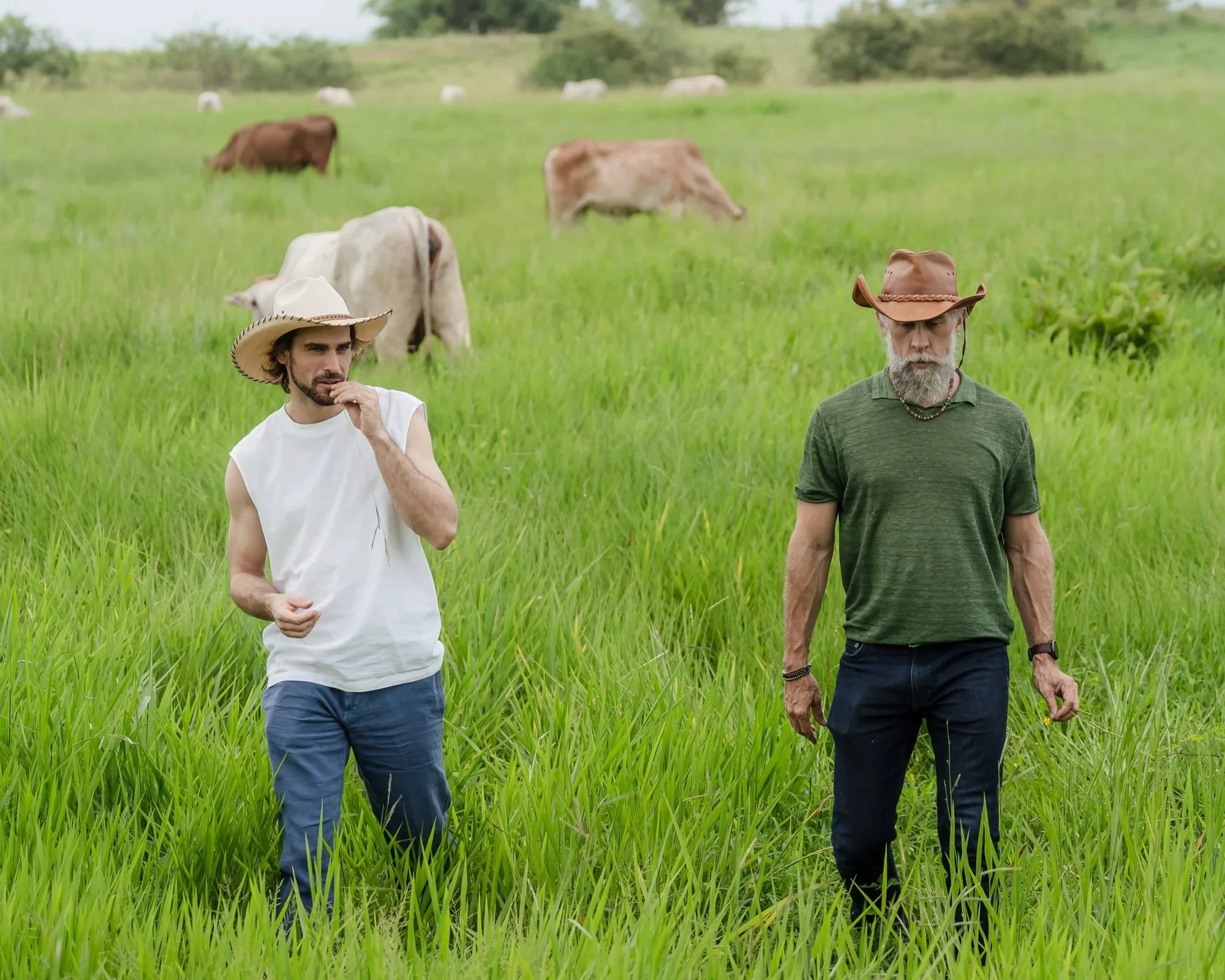
Thomas walks the land, checking on the grass.
Cultivating Community Through Food
As the farm stabilized, people began to take notice. Chefs, school groups, and visitors arrived not just to observe, but to taste and experience the difference. Agritourism emerged organically, driven by curiosity rather than marketing.
Thomas speaks candidly about Panama’s food culture, where convenience and presentation often outweigh questions of sourcing. Rather than waiting for demand to appear, Coquira became a place where people could encounter an alternative—where clean, thoughtfully grown food was not an abstract ideal but something felt directly.
These experiences reinforced a larger truth: food is one of the most effective entry points into conversations about health, ecology, and responsibility. When people understand where nourishment comes from, their relationship to land begins to shift.
“I have learned how liberating and how much freedom you have when you have access to your own small ecosystem.”

Food is central to Thomas and Adriana’s life
Why a Farm Village
Living on the farm brought clarity as well as fulfillment. Thomas and his wife, Adriana, experienced the physical benefits of rural life, but also its isolation. They realized that stewardship is not meant to be practiced alone.
Lega Vera grew from a simple desire for neighbors—people interested in land as a shared responsibility. Rather than creating a traditional agrihood where residents passively receive food, Lega Vera invites participation. Homes are paired with land, and residents are supported in cultivating it themselves.
To make this feasible, the project introduces a Farm Concierge model: shared tools, trusted labor, and operational support that lowers the barrier to entry for first-time land stewards. The goal is not perfection, but confidence, giving people the structure they need to learn, experiment, and grow into their role on the land.
“I wanted to give people the opportunity to become that farmer without the big learning curve.”

Rendering of Lega Vera Farm Village
Redefining Luxury
Throughout the conversation, Thomas returns to a central idea: true wealth today is not about excess but about autonomy. In a world shaped by fragile supply chains and environmental uncertainty, the ability to produce food, steward water, and live within a functioning ecosystem represents a different kind of security.
Lega Vera is designed for those who see land as a long-term commitment rather than a lifestyle accessory. It appeals to individuals and families who value resilience, intergenerational thinking, and the freedom that comes from participating directly in life’s essentials.
As Thomas says: “When you control your water, air, and food, something fundamental shifts. Life becomes less abstract. Responsibility becomes shared. And the land, once again, becomes a partner rather than a resource.”
For those who feel a pull toward Lega Vera in particular, turning interest into a lived reality requires more than enthusiasm—it requires discernment, alignment, and guidance. Latitude works closely with Thomas Patton and the Lega Vera team to help prospective residents understand the land, the vision, and the responsibility that comes with stewarding it. From early conversations about readiness and fit to navigating the practical steps of acquiring and inhabiting land at Lega Vera, Latitude serves as a trusted partner, helping ensure that those who arrive are prepared not just to live there but to participate meaningfully in the life of the place.
This podcast isn’t just about ideas—it’s about action. From these conversations, two organizations have emerged to bring regenerative real estate to life:
Latitude Regenerative Real Estate is the world’s first regenerative-focused real estate brokerage, dedicated to aligning values-driven buyers and sellers. With a strong presence in the Pacific Northwest and Great Lakes regions, Latitude also supports purpose-driven developments across North America through strategic marketing and branding services. If you're looking to buy, sell, or amplify a regenerative project, Latitude is your trusted partner.
Hamlet Capital is an investment and development firm committed to building resilient communities rooted in working farms. If you’re developing an agrihood or conservation community, we’d love to hear from you. Together, we can turn visionary ideas into thriving, place-based investments.